API Fundamentals
Essential terms and concepts for understanding how APIs work. From HTTP methods and status codes, to authentication, data formats, and request-response patterns that apply across different API types, this section defines the foundational building blocks of API communication.
API
Definition: acronym for application programming interface
- Application: software for end-users - not operating, administering or programming a computer
- Program: sequence of instructions for a computer to perform, often stored in a file
- Interface: program that runs on a computer and provides resources for other computers, programs, or services, also known as the server
Purpose: enables resource sharing - how one program or service uses the resources of another program or service, in which the resources are program functions, data, or shared devices that with other computers
Essential API Descriptions:
- What the program wants: procedure name, URL of resource
- Where they want it from: address/location of the procedure or resource
- How they want it: parameters to change or specify aspects of the request; response must be predictable for the program to use it effectively
Why Documentation Matters:
- acts as the contract between resources and programs using them
- without documentation, crossing the interface likely fails
- enables programmers to construct correct code
- prevents developers from needing to reverse-engineer, which is often prohibited by license
Example API Request-Response Flow:
Related Terms: API documentation testing, API endpoint, API gateway, API security, CLI, REST API
Source: UW API Docs: Module 5, Lesson 1, "REST API Fundamentals"
API endpoint
Definition: specific URL where an API can access resources; the touchpoint where clients interact with the API server to perform operations
Purpose: define the structure of API requests and enable developers to access specific resources or perform specific actions; each endpoint represents a distinct function or resource in the API
Key Characteristics:
- URL Structure: combines base URL with resource path
- HTTP Method: defines the operation -
GET,POST,PUT,DELETE - Unique Purpose: each endpoint performs a specific function
Example:
https://api.example.com/v1/users/123
Breaking down this endpoint:
- Base URL:
https://api.example.com - Version:
/v1 - Resource path:
/users/123 - Action: determined by HTTP method
GETretrieves user 123 whileDELETEremoves user 123
Common Endpoint Patterns:
| Pattern | Purpose | Example |
|---|---|---|
/resource | Collection operations | GET /users lists all users |
/resource/{id} | Single resource operations | GET /users/123 retrieves one user |
/resource/{id}/subresource | Related resources | GET /users/123/orders |
Related Terms: API, API documentation testing, HTTP, HTTP method, parameters, request-response, resource, REST API
Source: UW API Docs: Module 5, Lesson 1, "REST API Fundamentals"
API security
Definition: measures taken to protect APIs from unauthorized access, misuse, and attacks
Why Security Matters: APIs are commonly used to enable access to sensitive software functions and data - in result, they're becoming an increasingly desired target for attackers
authentication
Definition: determines who users are - a technique invented to overcome the weakness of shared credentials; an API authentication key is commonly a long series of numbers and letters that's included in a request header or request URL
authorization
Definition: determines what users can do - confirms users are who they claim to be by using techniques such as checking ID to verify identity
Related Terms: API, Bruno, environment variables, error handling, HTTPS, rate limiting, validation
Source: UW API Docs "Intentional Outcomes," Canvas Forum Thread
CRUD
Definition: acronym for Create, Read, Update, Delete; the four basic operations for persistent storage and data management in APIs
Purpose: provides a standard framework for API operations that maps directly to HTTP methods, making API design intuitive and predictable; CRUD operations form the foundation of most REST API interactions
HTTP Method Mapping:
| CRUD Operation | HTTP Method | Action | Example |
|---|---|---|---|
| Create | POST | Add new resource | POST /users creates a new user |
| Read | GET | Retrieve resource | GET /users/123 retrieves user 123 |
| Update | PUT or PATCH | Change resource | PUT /users/123 edits entire user record |
| Delete | DELETE | Remove resource | DELETE /users/123 removes user 123 |
Example: a typical CRUD API for managing blog posts supports creating
new posts via POST /posts, reading posts via GET /posts/{id}, updating
posts via PUT /posts/{id}, and deleting posts via DELETE /posts/{id}
Related Terms: DELETE, GET, HTTP method,
PATCH, POST, PUT, resource,
REST API
Sources:
- Mozilla Corporation, MDN: "HTTP request methods"
- UW API Docs: Module 2, Lesson 5: "Create a Master Prompt"
DELETE
Definition: HTTP method that requests removal of a specified resource from the server
Purpose: enables clients to delete records, remove files, or clean up resources through standardized HTTP operations
Example: sending DELETE /api/users/123 removes the user account
with ID 123 from the system
Related Terms: GET, HTTP method,
PATCH, POST, PUT
Source: Mozilla Corporation, MDN: "DELETE request method"
environment variables
Definition: dynamic values stored outside app code that configure program behavior across different deployment environments
Purpose: enables secure configuration management without hardcoding sensitive values; allows same codebase to work across development, staging, and production environments; often store configuration details, allowing tests to run in different environments without code changes
Example: API base URLs, authentication tokens, and database credentials stored as environment variables rather than committed to version control
Related Terms: API, API documentation testing, API security, authentication, Bruno
Source: Silva, Manny. Docs As Tests. First edition, Release 2, Boffin Education, May 2025.
error handling
Definition: the process of anticipating, detecting, and responding to errors that occur during API operations; includes both how the API communicates errors and how clients should handle them
Purpose: enables developers to build robust applications that gracefully handle failures, provide meaningful feedback to users, and recover from issues; good error handling documentation explains which errors can occur, what they mean, and how to resolve them
Example: when a client sends invalid data in a POST request,
the API returns a 400 Bad Request status code with a JSON response
body that specifies which fields are invalid and why:
Common Pattern:
{
  "error": "Bad Request",
  "message": "Invalid email format"
}
Note: This is the most widely used format, though field names vary
error, code, message, etc.
RFC 9457:
{
  "type": "https://api.example.com/errors/validation-error",
  "title": "Validation Error",
  "status": 400,
  "detail": "Invalid email format",
  "instance": "/users/123"
}
Note: This is a standardized format that provides machine-
readable error types and more context; uses application/problem+json
media type; less common but increasingly adopted by modern APIs;
only required field is type, defaults to "about:blank"
Related Terms: API, HTTP status codes, JSON, rate limiting, troubleshooting, validation
Sources:
- Baeldung: "Best Practices for REST API Error Handling"
- IETF RFC 9457 - Problem Details for HTTP APIs
- Mozilla Corporation, MDN: "HTTP response status codes"
GET
Definition: HTTP method that requests data from a server without modifying any resources; the most common method for retrieving information
Purpose: enables clients to read data, view resources, or query information while ensuring the request remains safe and idempotent
Example: sending GET /api/users/123 retrieves information about the
user with ID 123 without changing any data
Related Terms: DELETE, HTTP method,
idempotent, PATCH, POST, PUT
Source: Mozilla Corporation, MDN: "GET request method"
HTTP
Definition: acronym for Hypertext Transfer Protocol; synchronous request-response protocol that enables communication between clients and servers over the web; defines message format and transmission type, and how web servers and browsers should respond to a variety of commands
Purpose: HTTP forms the foundation of API communication;
understanding HTTP is essential for documenting API endpoints,
request methods- GET, POST, PUT, DELETE - status codes,
headers, and error handling; most RESTful APIs rely on HTTP
as their underlying protocol
Example: when a user submits a form on a website, the browser
sends an HTTP POST request to the server with the form data; the
server processes the request and returns an HTTP response with a
status code, such as 200 for success or 400 for a bad request,
and any relevant data
Related Terms: API endpoint, AsyncAPI, error-handling, HTTPS, HTTP status codes, HTTP versions, REST API
Source: IETF RFC 9110 - HTTP Semantics
HTTP method
Definition: verb that indicates the desired action to perform on a resource in an HTTP request; defines what operation the client wants the server to execute
Purpose: provides standardized semantics for API operations, making it clear whether a request reads, creates, updates, or deletes data
Example: REST APIs use methods like GET for reading,
POST for creating, PATCH for editing specific fields, PUT for
updating whole resources, and DELETE for removing resources
Related Terms: CRUD, DELETE, GET,
HTTP, PATCH, POST, PUT
Source: Mozilla Corporation, MDN: "HTTP request methods"
HTTPS
Definition: acronym for Hypertext Transfer Protocol Secure; encrypts communication between clients and servers using Transport Layer Security - TLS, or its predecessor, Secure Sockets Layer - SSL; HTTPS protects data from interception and tampering during transmission through encryption - the process of encoding data so only authorized parties can read it
Purpose: HTTPS is critical for API security documentation; all modern APIs should use HTTPS to protect sensitive data like authentication tokens, user credentials, and personal information; API documentation must specify HTTPS endpoints and explain security requirements
Security Note: while HTTPS provides security, it's not an API security measure or technique, but a protocol implementation; security is one aspect of HTTPS, but not its defining characteristic
Example: when users log into a banking app, their credentials travel over HTTPS; the encrypted connection ensures that even if someone intercepts the network traffic, they can't read the username, password, or account information
Related Terms: API security, authentication, HTTP, HTTP versions
Source: IETF RFC 9110 - HTTP Semantics
HTTP status codes
Definition: three-digit codes returned by servers in HTTP responses that show whether a specific request succeeded or failed, and why
Purpose: status codes enable developers to handle different response scenarios appropriately, add proper error handling, and debug API issues; API documentation must explain which status codes an endpoint returns and what they mean
Status Code Categories:
| Code Range | Category | Meaning |
|---|---|---|
| 1xx | Informational | Request received, continuing process |
| 2xx | Success | Request successfully received, understood, and accepted |
| 3xx | Redirection | Further action needed to complete the request |
| 4xx | Client Error | Request contains bad syntax and/or server can't process |
| 5xx | Server Error | Server failed to fulfill an apparently valid request |
Common Status Codes:
| Code | Label | Meaning |
|---|---|---|
200 | OK | Request succeeded |
201 | Created | New resource successfully created |
204 | No Content | Request succeeded but no content to return |
400 | Bad Request | Server can't process due to client error |
401 | Unauthorized | Authentication required or failed |
403 | Forbidden | Server understood but refuses to process |
404 | Not Found | Requested resource doesn't exist |
500 | Internal Server Error | Server encountered an unexpected condition |
503 | Service Unavailable | Server temporarily unable to handle request |
Client requests a user that doesn't exist:
GET https://api.example.com/users/999
Response:
{
  "status": 404,
  "error": "Not Found",
  "message": "User with ID 999 does not exist"
}
Related Terms: API documentation testing, API endpoint, HTTP, rate limiting, request-response, REST API, troubleshooting, validation
Source: IETF RFC 9110 - HTTP Semantics
HTTP versions
Definition: iterations of the Hypertext Transfer Protocol with different performance and feature capabilities; HTTP/1.1 (1997) uses sequential requests, HTTP/2 (2015) enables concurrent requests over one connection, HTTP/3 (2022) uses QUIC protocol - originally Quick UDP Internet Connections, now just QUIC - for improved reliability
Purpose: understanding version differences helps explain why certain API architectures like gRPC require specific HTTP versions for their performance characteristics
Example: a gRPC API requires HTTP/2 because it relies on features like multiplexing and bidirectional streaming that aren't available in HTTP/1.1
Related Terms: gRPC API, HTTP, HTTPS, REST API
Source: IETF RFC 9110 - HTTP Semantics
idempotent
Definition: describes an operation that produces the same result regardless of how many times it's executed; making the same request many times has the same effect as making it once
Purpose: enables safe request retries without unintended side effects; critical for network reliability when timeouts and/or connection issues risk request duplication
Example: DELETE /users/123 is idempotent as deleting the same user
many times results in the same state: "user deleted" - while POST /users
isn't idempotent, as posting the same user data many times creates
many user records
HTTP Methods & Idempotency:
| Method | Idempotent | Reason |
|---|---|---|
DELETE | Yes | Deleting an already-deleted resource has same outcome |
GET | Yes | Reading data doesn’t change server state |
PATCH | Depends | Partial updates may or may not be idempotent based on implementation |
POST | No | Creating resources many times produces different results |
PUT | Yes | Replacing a resource with the same data produces identical result |
Related Terms: DELETE, GET,
HTTP method, POST, PUT
Source: IETF RFC 9110 - HTTP Semantics: Section 9.2.2
JSON
Definition: acronym for JavaScript Object Notation; a lightweight, text-based data format that uses human-readable key-value pairs to represent structured data
Purpose: provides an efficient way to exchange data between clients and servers; JSON has become the dominant format for modern REST APIs due to its readability, compact size, and native compatibility with JavaScript
Key Characteristics:
- Objects: collections of key-value pairs enclosed in curly braces
{} - Arrays: ordered lists of values enclosed in square brackets
[] - Values: can be strings, numbers, booleans,
null, objects, or arrays - Properties: keys that identify values within objects
Example:
{
  "id": 123,
  "firstName": "Jane",
  "lastName": "Doe",
  "email": "jane.doe@example.com",
  "active": true,
  "roles": ["user", "admin"],
  "address": {
    "street": "123 Main St",
    "city": "Seattle",
    "state": "WA"
  }
}
Common API Use Cases:
| Use Case | Example |
|---|---|
| Request body | Sending data in POST or PUT requests |
| Response body | Returning data from API endpoints |
| Configuration | Storing API settings and options |
| Error messages | Structured error information |
Related Terms: JSON-RPC, payload, REST API, serialization, XML, YAML
Source: JSON.org: "Introducing JSON"
message broker
Definition: intermediary software component that receives, stores, routes, and delivers messages between applications, services, or systems using messaging protocols
Purpose: enables asynchronous communication patterns where senders and receivers don't need to interact with messages simultaneously; decouples app components, improves scalability, and provides message persistence and delivery guarantees; essential for event-driven architectures and real-time data processing
Publish-Subscribe Pattern: message brokers commonly use publish-subscribe messaging where publishers send messages to topics without knowing who'll receive them, and subscribers receive messages from topics they're interested in without knowing who sent them; this decoupling allows independent scaling and evolution of system components
Example: e-commerce order processing with message broker
| Component | Action | Benefit |
|---|---|---|
| Web app | Publishes order message to broker | Responds to customer immediately |
| Inventory system | Subscribes to order messages | Updates stock independently |
| Payment system | Subscribes to order messages | Processes payment asynchronously |
| Shipping system | Subscribes to order messages | Arranges delivery in parallel |
Related Terms: AMQP, API, AsyncAPI, event-driven, Kafka, MQTT
Sources:
parameters
Definition: variables passed in API requests to specify or filter the data returned, change behavior, or provide necessary information for the operation
Purpose: parameters enable flexible, precise API requests without requiring separate endpoints for every variation; API documentation must describe each parameter's purpose, data type, whether it's required or optional, and valid values
Parameter Types:
| Type | Location | Purpose | Example |
|---|---|---|---|
| Path parameters | In the URL path | Identify specific resources | /users/{id} |
| Query parameters | After ? in URL | Filter, sort, or paginate results | /users?role=admin&limit=10 |
| Header parameters | HTTP headers | Authentication, content type | Authorization: Bearer token123 |
| Body parameters | Request body | Complex data for POST/PUT | JSON object with user details |
Example Using Many Parameter Types:
GET https://api.example.com/v1/users/123/orders?status=pending&limit=5
Authorization: Bearer abc123xyz
Break Down the Parameters:
- Path parameter:
123- user ID - Query parameters:
status=pendingandlimit=5 - Header parameter:
Authorization: Bearer abc123xyz
Documentation Requirements for Each Parameter:
- Name and data type - string, integer, boolean
- Whether it's required or optional
- Valid values or format
- Default value if applicable
- Description of what it does
Related Terms: API endpoint, request-response, REST API
Source: UW API Docs: Module 5, Lesson 1, "REST API Fundamentals"
payload
Definition: the actual data transmitted in an API request or response body, excluding headers and metadata; contains the information sent and/or received
Purpose: distinguishes the meaningful content from the technical transmission details; understanding payload structure is essential for API documentation as it defines what data clients send and receive
Example: in a POST /users request, the payload contains the data
required to create a user:
{
  "firstName": "Alice",
  "lastName": "Smith",
  "email": "alice@example.com",
  "role": "developer"
}
Common Payload Formats:
| Format | Use Case | Example |
|---|---|---|
| JSON | Most REST APIs | {"name": "value"} |
| XML | Legacy systems, SOAP | <name>value</name> |
| Form data | File uploads, form submissions | name=value&email=user@example.com |
| Binary | File transfers, images | Raw bytes |
Related Terms: HTTP method, JSON, request-response, REST API, serialization, XML
Sources:
- Mozilla Corporation, MDN: "HTTP Messages"
- UW API Docs: Module 2, Lesson 5: "Create a Master Prompt"
PATCH
Definition: HTTP method that applies partial modifications to an existing resource; sends only the fields that need updates rather than the entire resource
Purpose: enables clients to update specific fields of a resource efficiently without sending unchanged data; reduces bandwidth usage and streamlines updates when only a few fields need modification
Example: sending PATCH /api/users/123 with a JSON body
containing {"email": "newemail@example.com"} updates only the email
field of user 123, leaving other fields like name and
phone_number unchanged
Related Terms: DELETE, GET,
HTTP method, POST, PUT
Source: Mozilla Corporation, MDN: "PATCH request method"
POST
Definition: HTTP method that submits data to a server to create new resources or trigger actions; submission data typically includes a request body
Purpose: enables clients to add new records, submit forms, upload files, or execute operations that change server state
Example: sending POST /api/users with a JSON body containing
{"name": "Alice", "email": "alice@example.com"} creates a
new user account
Related Terms: DELETE, GET,
HTTP method, PATCH, PUT,
webhook API
Source: Mozilla Corporation, MDN: "POST request method"
PUT
Definition: HTTP method that replaces an existing resource with new data or creates a resource at a specific URL if it doesn't exist
Purpose: enables clients to update entire resources with complete
replacement semantics; differs from PATCH which performs partial
updates
Example: sending PUT /api/users/123 with a complete user object
replaces all existing data for user 123 with the new data
Related Terms: DELETE, GET,
HTTP method, idempotent,
PATCH, POST
Source: Mozilla Corporation, MDN: "PUT request method"
rate limiting
Definition: mechanism that restricts the number of API requests a client can make within a specified time window; protects servers from overload and ensures fair resource distribution
Purpose: prevents abuse, maintains service stability, and ensures fair access for all users; API documentation must explain rate limits, how they're enforced, and what happens as they're exceeded
Security Implications: rate limiting is a fundamental operational and/or data handling concept that affects all API usage - not just security scenarios; it's about resource management, fair access, and system stability as much as it's about preventing abuse
Common Rate Limiting Patterns:
| Pattern | Description | Example |
|---|---|---|
| Fixed window | Set number of requests per time unit | 1000 requests per hour |
| Sliding window | Rolling time window for more precision | 1000 requests per 60-minute window |
| Token bucket | Requests consume tokens that regenerate | 10 tokens/second, burst up to 100 |
| Per-user | Limits apply to individual users/keys | 100 requests/minute per API key |
Example: an API with rate limiting returns 429 Too Many Requests
when a client exceeds the rate limit, along with headers indicating when
the client can retry:
HTTP/1.1 429 Too Many Requests
X-RateLimit-Limit: 1000
X-RateLimit-Remaining: 0
X-RateLimit-Reset: 1704398400
Retry-After: 3600
Related Terms: API security, authentication, authorization, error handling, HTTP status codes, validation
Sources:
- IETF RFC 6585 - Additional HTTP Status Codes: Section 4
- Mozilla Corporation, MDN: "429 Too Many Requests"
- UW API Docs: Module 2, Lesson 5, "Create a Master Prompt"
request-response
Definition: two-part communication pattern in API interactions where a client sends a request to a server and receives a response
Purpose: understanding the request-response cycle is fundamental to using and documenting APIs; documentation must show what requests look like, what data to include, and what responses to expect
Request Components:
| Component | Description | Example |
|---|---|---|
| HTTP method | Action to perform | GET, POST, PUT, DELETE |
| Endpoint URL | Resource location | https://api.example.com/users |
| Headers | Metadata about the request | Content-Type: application/json |
| Body | Data sent with request - POST/PUT | JSON object |
| Parameters | Request specifications | Query or path parameters |
Response Components:
| Component | Description | Example |
|---|---|---|
| Status code | Outcome of the request | 200, 404, 500 |
| Headers | Metadata about the response | Content-Type: application/json |
| Body | Data returned from server | JSON object |
Example Request:
POST https://api.example.com/users
Content-Type: application/json
Authorization: Bearer token123

{
  "first_name": "Jane",
  "last_name": "Doe",
  "email": "jane.doe@example.com"
}
Example Response:
HTTP/1.1 201 Created
Content-Type: application/json

{
  "id": 456,
  "first_name": "Jane",
  "last_name": "Doe",
  "email": "jane.doe@example.com",
  "created_at": "2025-12-30T10:30:00Z"
}
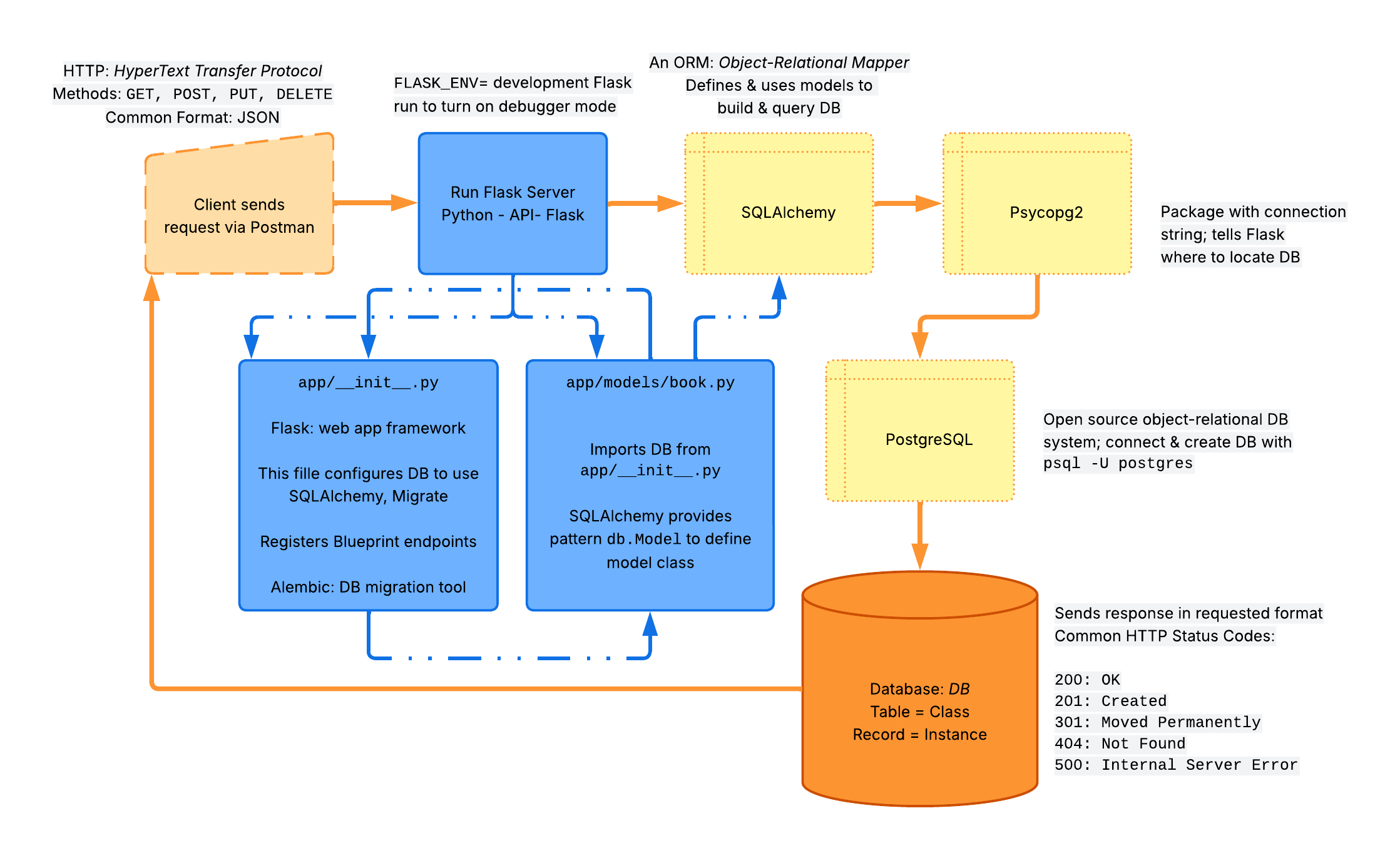
Request-Response Cycle - Python, Postman, PostgreSQL
Related Terms: API endpoint, HTTP, HTTP method, HTTP status codes, parameters, REST API
Source: UW API Docs: Module 5, Lesson 1, "REST API Fundamentals"
resource
Definition: a distinct piece of data or entity available for reference or modification through an API; REST architecture fundamental concept in which everything is a resource with a unique identifier
Purpose: provides a consistent mental model for API design and usage; resources map to real-world entities and enable intuitive API structures where URLs represent resources and HTTP methods represent actions on those resources
Key Characteristics for Each Resource:
- Unique Identifier: has a distinct URI or ID
- Representations: return in different formats like JSON or XML
- State: have properties available for reading or updating
- Relationships: can relate to other resources
Common Resource Types:
| Type | Example | Typical Operations |
|---|---|---|
| Collection | /users | List all, create new |
| Individual | /users/123 | Read, edit, delete one |
| Nested | /users/123/orders | Access related resources |
| Singleton | /profile | Read or change single instance |
Example: in an e-commerce API, resources include users, products,
orders, and payments; each resource type has its own endpoint structure
like /products/456 for a specific product resource
Related Terms: API endpoint, CRUD, HTTP method, REST API, URI, URL
Sources:
- IETF RFC 9110 - HTTP Semantics: Section 3.1
- UW API Docs: Module 2, Lesson 5: "Create a Master Prompt"
schema
Definition: also know as the Schema Object, the formal definition that describes the structure, data types, constraints, and relationships within an API's requests and responses
Purpose: enables validation, auto-generated documentation, and type safety; helps both API providers and consumers understand exactly what data format to expect
Example: an OpenAPI schema defines that a POST /users endpoint
requires a request body with string type for email field and integer type
for age field
Related Terms: API, API endpoint, GraphQL API, OpenAPI specification, request-response, validation
Sources:
SDK
Definition: acronym for software development kit; a collection of tools, libraries, code samples, and documentation that enables developers to build applications using a specific platform, service, or API
Purpose: streamlines API integration by providing pre-written code that handles authentication, request formatting, error handling, and response parsing; allows developers to use APIs in their preferred programming language without writing low-level HTTP requests; reduces integration time and errors by abstracting API complexity into language-specific methods and classes
SDK vs client library
While often used interchangeably, an SDK technically includes more than just a client library, it bundles the library with documentation, code examples, CLI tools, and other development resources; in API documentation contexts, "SDK" and "client library" both refer to language-specific code for consuming APIs, with SDK being the more common modern term
Example: compare the developer experience between using cURL commands vs using a Python SDK; technical writers must document all SDK methods, parameters, usage examples, and any additional and/or underlying API reference documentation
# raw cURL approach
curl https://api.stripe.com/v1/charges \
  -u sk_test_key: \
  -H "Content-Type: application/x-www-form-urlencoded" \
  -d amount=1000 \
  -d currency=usd
# Python SDK approach
stripe.Charge.create(
    amount=1000,
    currency="usd"
)
Related Terms: API, cURL, developer portal, Fern, OpenAPI Specification, REST API, Speakeasy
Sources:
- Amazon Web Services, Developer Tools: "What is an SDK?"
- GitHub, Inc.: "What is an SDK?"
- IBM: "SDK vs API: What's the difference?"
serialization
Definition: the process of converting data structures and/or objects into a format appropriate for network transmission or storage, then reconstructed later
Purpose: enables data exchange between systems by transforming programming language objects into formats like JSON, XML, or binary that can travel across network boundaries
Example: serializing a JavaScript user object {name: "Alice", age: 30}
into JSON string {"name":"Alice", "age":30} before sending it in an
API request
Related Terms: JSON, payload, Protocol Buffers, XML, YAML
Source: Mozilla Corporation, MDN: "Serialization"
URI
Definition: acronym for Uniform Resource Identifier; standard format for identifying resources in a way that enables consistent reference across different systems; identifies a resource but doesn't necessarily specify how to locate or access it
Purpose: provides a unified way to name resources regardless of their location or access method; forms the foundation for both URLs and URNs - Uniform Resource Names - creating a consistent identification system across the web
Example: mailto:user@example.com is a URI that identifies an
email address resource; urn:isbn:0-486-27557-4 is a URI that
identifies a book by its ISBN - International Standard Book Number;
both identify resources without specifying network locations
Related Terms: API endpoint, HTTP, resource, REST API, URL
Source: IETF RFC 3986 - Uniform Resource Identifier (URI): Generic Syntax
URL
Definition: acronym for Uniform Resource Locator; specific URI type that not only identifies a resource but also provides the means to locate it on a network by describing its primary access mechanism and network location
Purpose: enables clients to locate and retrieve resources over the web; essential for API documentation as URLs define exactly where endpoints exist and how to reach them
Example:
https://api.example.com:443/v1/users/123?include=orders
Break Down This URL:
| Category | Component | Example | Description |
|---|---|---|---|
| how | schema | https:// | protocol for accessing the resource |
| where | host | api.example.com | server location |
| optional | port | :443 | HTTPS default, directs traffic |
| what | endpoint/path | /v1/users/123 | specific resource location |
| optional | query parameters | ?include=orders | request modifications |
Related Terms: API endpoint, HTTP, parameters, resource, REST API, schema, URI
Sources:
- IETF RFC 3986 - Uniform Resource Identifier (URI): Generic Syntax
- Mozilla Corporation, MDN: "What is a URL?"
validation
Definition: process of checking whether data meets specified rules, constraints, and format requirements before processing or storage
Purpose: ensures data quality, prevents errors, and protects systems from invalid input; improves API reliability by catching problems early
Security Implications: validation is a fundamental operation that happens on every request regardless of security context - even authenticated and authorized users need their input validated; while primarily a core data handling concept, validation can also prevent injection attacks and enforce data constraints
Example: validating that an email field contains a properly formatted email address and that an age field contains a positive integer before creating a user account
Related Terms: API security, error handling, HTTP status codes, rate limiting, schema
Sources:
- OpenAPI Initiative: "Data Validation"
- Open Worldwide Application Security Project - OWASP: "API data validation - API security"