Frameworks & Strategy
Meta-level frameworks and strategic approaches for API documentation work. This section covers evaluation frameworks for API usability, developer personas, organizational contexts, and market dynamics - the conceptual models that inform how documentation teams plan and execute their work. For technical API architectures and implementation patterns, see API Types & Architectures.
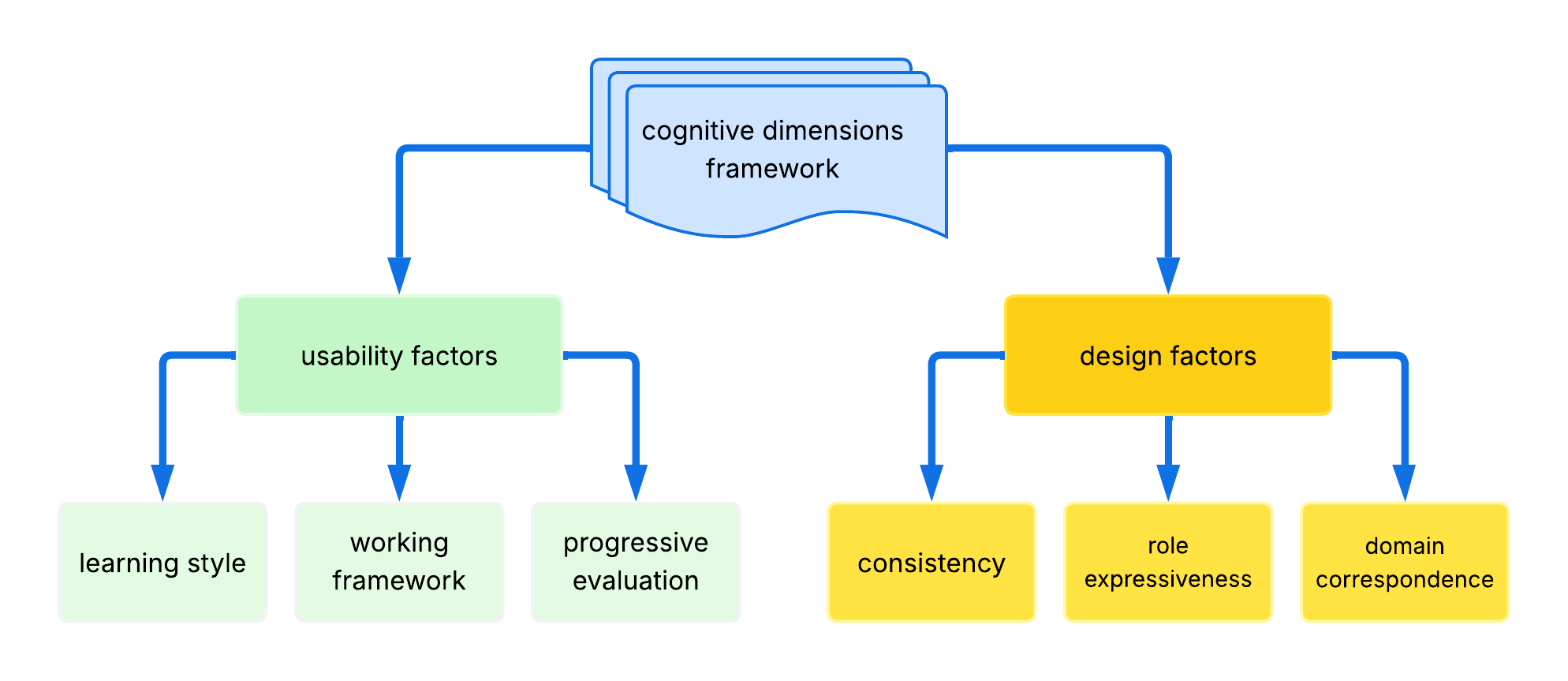
Explore the cognitive dimensions framework:
accessibility
Definition: the practice of designing and creating content, interfaces, and experiences that people with diverse abilities, disabilities, and contexts can perceive, understand, navigate, and interact with effectively
Purpose: ensures API documentation reaches all developers regardless of visual, auditory, motor, or cognitive abilities; guides decisions about color contrast, text sizing, navigation patterns, code example formatting, and content structure to create inclusive documentation experiences
Why this belongs in Frameworks & Strategy: represents a fundamental
design philosophy and ethical framework that informs all documentation decisions
rather than a specific workflow or tool; a strategic approach to inclusive
design that shapes content strategy, IA, and UX - similar to how
docs-as-ecosystem frames documentation philosophy rather than describing
operational practices
The Complexity of Accessibility: accessibility isn't one-size-fits-all - design choices that improve access for some users may create barriers for others, requiring documentation teams to provide flexible options rather than single "accessible" solutions
Example: light vs. dark mode
| Mode | Benefits | Challenges |
|---|---|---|
| Light Mode | Better for users with astigmatism, dyslexia, or certain visual processing conditions; higher contrast can improve readability for many | Can cause eye strain for users with light sensitivity, migraines, or who work in low-light environments |
| Dark Mode | Reduces eye strain for light-sensitive users, better for low-light conditions, can help users with certain forms of photophobia | Can reduce readability for users with astigmatism or visual processing conditions; lower contrast may be harder to read for some |
Solution: provide both modes as user-selectable options rather than enforcing a single "accessible" choice, allowing developers to choose what works best for their needs and context; additional accessibility solutions for doc teams -
- screen reader compatibility for code examples and interactive elements
- keyboard navigation for documentation sites and API explorers
- sufficient color contrast in syntax highlighting while maintaining code readability
- alternative text for diagrams showing API architecture or data flows
- clear heading hierarchy for navigation and comprehension
- captions or transcripts for video tutorials
- plain language explanations alongside technical terminology
Related Terms: banner blindness, content strategy, diagrams-as-code, docs-as-ecosystem, DX, guerilla usability testing, information architecture, usability testing, UX
Sources:
- Utah State University, WebAIM: "Contrast and Color Accessibility"
- W3C: "How to Meet WCAG (Quick Reference)"
- W3C Web Accessibility Initiative (WAI)
cognitive dimensions of API usability
Definition: a framework for evaluating and enhancing API usability by considering both designer and user perspectives to identify usability issues and guide design improvements
Purpose: provides a structured approach to assess API design quality across 12 dimensions, helping documentation teams identify where users might struggle and where documentation can provide the most value; guides documentation planning by highlighting which API aspects need clearer explanation or examples
the 12 dimensions
| Dimension | What it evaluates |
|---|---|
| Abstraction Level | Range of abstraction levels the API exposes and their usability for target developers |
| Learning Style | Learning requirements and how well they align with developers' available learning styles |
| Working Framework | Size of the conceptual chunk developers must hold in mind to work effectively - cognitive load |
| Work-Step Unit | Amount of a task developers complete in a single step |
| Progressive Evaluation | Degree to which developers can run incomplete code for feedback |
| Premature Commitment | Number of early decisions developers must make and their consequences |
| Penetrability | How easily the API facilitates exploration, analysis, and understanding of its components |
| API Elaboration | Degree to which the API needs adaptation or extension for specific developer needs |
| API Viscosity | Inherent barriers to change and effort required for developers to make modifications |
| Consistency | Uniformity and predictability of design, naming conventions, and behavior |
| Role Expressiveness | How plainly the API communicates the roles and responsibilities of its components |
| Domain Correspondence | How well the API's structure and terminology map to the problem domain |
Example: when documenting an authentication API with high premature commitment, in which developers must choose OAuth vs. API keys early, documentation should provide a clear decision guide upfront rather than burying the comparison deep in reference docs
Related terms: API, API reference topic, curse of knowledge, Diátaxis, DX, end-user software engineer, usability testing, UX
Sources:
- Docs By Design: "Applying the Cognitive Dimensions of API Usability to Improve API Documentation Planning" by Robert Watson
- Docs By Design: "Audience, Market, Product Webinar"
content governance
Definition: framework of policies, standards, ownership structures, and lifecycle processes that define how docs are created, reviewed, maintained, and retired across an org or docs system
Purpose: ensures docs remain accurate, consistent, and trustworthy at scale — establishes who owns each piece of content, what standards apply, when content requires review, and how outdated or conflicting material gets resolved; particularly critical in API docs where content spans multiple teams, product versions, and external audiences
content governance vs style guide
| Style Guide | Content Governance | |
|---|---|---|
| Defines | How to write — tone, formatting, terminology | Who writes what, when it gets reviewed, what happens when content becomes inaccurate or outdated |
| Scope | A single artifact | A system of policies and processes |
| Relationship | One artifact that governance may require and enforce | The framework that can mandate a style guide |
Example: an API docs team establishes a governance framework that assigns endpoint docs ownership to the engineering team that built the endpoint, requires a quarterly accuracy review cycle tied to release milestones, and defines a deprecation process for removing docs when endpoints are sunset; writers maintain the standards, but governance determines accountability and lifecycle
Related Terms: content, content strategy, docs-as-code, docs-as-tests, documentation audit, information architecture, knowledge management, tone
Sources:
- Content Science Review: "What Is Content Governance?" by Colleen Jones
- Templafy: "Content Governance: best practices & tools to build a model that works" by Glen Hagensen
content strategy
Definition: discipline encompassing the planning, development, and management of content across its entire lifecycle; encompasses content creation, governance, delivery, and measurement to meet both user needs and business goals
Purpose: ensures API documentation efforts align with organizational objectives, user needs, and resource constraints by defining what content to create, how to maintain it, who's responsible, and how to measure success
Example: content strategy for API documentation
| Priority | Activity | Rationale |
|---|---|---|
| Q1 | prioritize authentication and getting-started guides | highest-impact pages for new API users |
| Ongoing | engineer review before publication | validates technical accuracy |
| Versioning | maintain version-specific documentation | ensures backward compatibility |
| Metrics | track time-to-first-successful-API-call | measures effectiveness of documentation |
Related Terms: accessibility, content, content governance, curse of knowledge, docs-as-ecosystem, documentation audit, information architecture, knowledge management, market, ontology, sales collateral, technical communication
Sources:
- Kovai.co, Document360: "Technical Content Strategy: A Practical Guide to Smarter Documentation" by Janeera D.A.
- Wikipedia: "Content strategy"
Diátaxis
Definition: a systematic framework for organizing technical documentation into four distinct content types: tutorials, how-to guides, reference, and explanation - based on whether content serves acquisition or knowledge use, and whether it's focused on practical steps or theoretical knowledge
Purpose: provides documentation teams with a structured approach to content planning and organization by identifying which documentation type to create and how to write it; helps prevent common documentation problems like mixing instructional content with reference material or explanations with tutorials, resulting in clearer, more user-friendly documentation that serves both beginners and experts effectively
the four content types
| Content Type | Orientation | Focus | User Question |
|---|---|---|---|
| Tutorial | Learning | Practical steps | "Can you teach me to - ?" |
| How-to Guide | Goals | Practical steps | "How do I - ?" |
| Reference | Information | Theoretical knowledge | "What is - ?" |
| Explanation | Understanding | Theoretical knowledge | "Why - ?" |
The Framework's Two Axes:
- Acquisition vs. Application: whether users are learning something new, acquisition, or applying existing knowledge to complete work, application
- Practical Steps vs. Theoretical Knowledge: whether content focuses on doing, practical steps, or understanding, theoretical knowledge
Example: when documenting a payment API, Diátaxis guides writers to create separate content types rather than combining all approaches into one confusing page
| Content Type | Title | Orientation | Focus |
|---|---|---|---|
| Tutorial | "Process your first payment" | Learning | Practical |
| How-to Guide | "Handle payment failures" | Goals | Practical |
| Reference | "Payment API reference" | Information | Theoretical |
| Explanation | "How payment processing works" | Understanding | Theoretical |
Related Terms: cognitive dimensions of API usability, content, domain knowledge, end-user software engineer, explanation guide, how-to guide, information architecture, reference, tutorial
Sources:
docs-as-ecosystem
Definition: comprehensive framework for treating documentation as a complex, dynamic system managed and nurtured through collaboration across diverse stakeholders rather than as static code or isolated content
Purpose: expands beyond docs-as-code by recognizing that documentation encompasses technical writing, design, community feedback, community management, accessibility, SEO - search engine optimization - UX, and AI tools; encourages holistic, multidisciplinary, and community-centered approaches to creating and maintaining API documentation that foster sustained engagement and collaborative growth
Why this belongs in Frameworks & Strategy: represents a conceptual paradigm
shift in how organizations approach documentation rather than a specific
operational workflow; docs-as-ecosystem expands the operational approaches of
docs-as-code and docs-as-tests into a broader strategic framework that
encompasses the full complexity of documentation systems beyond just code
management and testing practices
| Term | Category | Focus |
|---|---|---|
| docs-as-code | Workflows & Methodologies | methodology for organizing documentation work using developer tools and processes |
| docs-as-tests | Workflows & Methodologies | concrete practice of running automated tests against documentation |
| docs-as-ecosystem | Frameworks & Strategy | meta-level philosophy and organizational mindset for understanding documentation as a living system with multiple stakeholders, feedback loops, and interdisciplinary components |
Example: rather than treating API documentation as markdown files managed only by technical writers, a docs-as-ecosystem approach establishes feedback channels through GitHub discussions, social media, and forums, involves developer relations in analyzing feedback trends, coordinates with product managers on documentation roadmap, and integrates contributions from engineers, community members, and customer support to create living documentation that evolves with community needs
Related Terms: accessibility, Agile, content strategy, DAM, docs-as-code, docs-as-tests, docs observability, domain knowledge, end-user software engineer, knowledge management, ontology, RAG, Seven-Action Documentation Model, technical communication, usability testing
Sources:
- Docs-as-Ecosystem: "The Community Approach to Engineering Documentation" by Alejandra Quetzalli
- GovFresh: "Docs-as-Ecosystem" Review by Luke Fretwell
docs observability
Definition: also known as do11y; practice of treating docs as an instrumented, observable component of a product system — tracking how users move between docs and product to measure whether the docs are achieving its goals
Purpose: connects docs success directly to product metrics rather than relying on indirect signals like page views or support ticket volume; treats docs are part of a distributed system rather than an ancillary element, enabling tech writers to move from defensive output metrics — pages published, tickets closed — toward infrastructure and product metrics that reflect docs' role in org success; examples of what this framing makes measurable:
- At which point during product usage were docs consumed?
- Was consumption of docs followed by normal operation?
- Did docs help in setting up or configuring a feature?
- Did reading a doc correlate with a decrease in support tickets for that feature?
- Did documented processes show a higher success or conversion rate?
Treating docs as observable infrastructure means measuring docs the same way infrastructure performance is measured: by the efficiency of the processes that rely on it and the incidents avoided by maintaining it; treating docs as a product means applying product engagement metrics — returning users, satisfaction scores, feature adoption — rather than isolated content metrics
Why this belongs in Frameworks & Strategy: describes a strategic
frame for how docs teams plan, design, and measure content
infrastructure — not a specific workflow or tool; similar to
docs-as-ecosystem, it reframes the relationship between
docs and product rather than prescribing how docs get made; the technical
implementation - instrumentation, session tracking,
RUM, real user monitoring,
is secondary to the mindset shift
do11y vs related terms
| Term | Description | Distinction |
|---|---|---|
| web analytics | measures activity on docs in isolation — page views, time on page, bounce rate | docs observability correlates that activity with product behavior, tracking the user journey across both docs and product to determine whether reading a doc preceded successful product usage |
| usability testing | captures qualitative feedback from representative users in controlled conditions | docs observability instruments real user behavior at scale, trading depth of insight for breadth and continuity |
| docs-as-tests | validates that docs content is accurate relative to the product | docs observability measures whether accurate docs are actually helping users succeed — complementary practices operating at different layers of the same problem |
Example: check whether your company uses an observability solution and request access, involve engineers in a proof of concept scoped to a handful of docs and a specific feature, verify that the docs tooling supports instrumentation to emulate and/or implement the following scenario -
An API returns an error response with a link embedded in the payload pointing to the relevant doc; the user follows it, realizes their mistake, modifies a parameter, and successfully completes the call; a dashboard tracks how many users made a successful API call after reading that doc — connecting docs consumption directly to product success
Related Terms: docs-as-code, docs-as-ecosystem, docs-as-tests, DX, Seven-Action Documentation Model, usability testing, UX
Sources:
- Docs By Design: "Why I'm passionate about content metrics" by Bob Watson
- passo.uno: "Docs observability, or measuring docs inside a product-docs system" by Fabrizio Ferri Benedetti
- passo.uno: "Measure it till you make it" by Fabrizio Ferri Benedetti
domain knowledge
Definition: the understanding of a specific industry, discipline, or activity
Purpose: enables technical writers to communicate effectively with subject matter experts and create accurate, contextually appropriate API documentation; writers with domain knowledge can better assess what information developers need, ask informed questions during research, and identify gaps or inaccuracies in documentation
Example: a technical writer documenting a financial trading API benefits from domain knowledge of trading terminology, market mechanics, and regulatory requirements - allowing them to write clearer explanations of rate limiting during market hours or authentication requirements for different account types
Related Terms: API, curse of knowledge, Diátaxis, docs-as-ecosystem, DSL, end-user software engineer, information architecture, knowledge management, ontology, progressive disclosure, RAG, taxonomy, technical communication
Source: Parson: "API documentation - What software engineers can teach us" by Stephanie Steinhardt
DX
Definition: also known as DevEx, acronym for developer experience; multidisciplinary field that combines principles from human-computer interaction, UX, organizational psychology, and software engineering to optimize development; overall experience developers have when discovering, learning, integrating, and maintaining a software product, API, or tool
Purpose: frames API documentation work within the broader context of how developers interact with an API throughout their journey - from initial discovery to production deployment - helping documentation teams understand that docs are just one touchpoint in the overall developer experience
Example: strong developer experience for a payment API
| Focus Area | What It Includes | Why It Matters |
|---|---|---|
| Getting Started | Comprehensive guides leading to a successful test transaction | Targets under 10 minutes to first successful transaction, a key DX benchmark |
| Exploration | Interactive API explorer for testing without writing code | Lowers the barrier to entry for non-developers evaluating the API |
| SDKs | Libraries in popular languages with consistent patterns | Reduces integration time and cognitive overhead across tech stacks |
| Error Handling | Clear error messages with links to relevant docs | Keeps developers in flow, troubleshooting without leaving the platform |
| Community | Active forums for developer support and discussion | Provides peer-driven support and real-world usage examples |
| Testing Tools | Webhook testing utilities | Enables developers to verify event-driven integrations locally before deployment |
Related Terms: accessibility, API playground, API sandbox, banner blindness, cognitive dimensions of API usability, CTA, curse of knowledge, developer portal, docs observability, end-user software engineer, error handling, getting started, SDK, Seven-Action Documentation Model, usability testing, UX
Sources:
- Atlassian: "What is developer experience & why is it important?"
- GitLab Inc.: "What is developer experience?"
- Wikipedia: "Developer experience"
end-user software engineer
Definition: a framework for categorizing developer work styles, characteristics, and motivations into distinct personas
Purpose: helps documentation teams understand different developer approaches to learning and using APIs, enabling targeted content that matches how each persona works; systematic developers need comprehensive reference documentation, pragmatic developers favor structured guides, and opportunistic developers require quick-start examples and business-focused explanations
the three personas
| Persona | Approach | Pride | Documentation Needs |
|---|---|---|---|
| Systematic Developer | Writes code defensively, develops deep understanding before using technology | Building elegant solutions | Comprehensive reference, architectural overviews, edge case documentation |
| Pragmatic Developer | Writes code methodically, develops enough understanding to use technology | Building robust apps | Structured tutorials, best practices, troubleshooting guides |
| Opportunistic Developer | Writes code in exploratory fashion, develops enough understanding to solve business problems | Solving business problems | Quickstart guides, business use cases, code examples |
Example: when documenting a payment processing API, systematic developers need detailed security architecture documentation, pragmatic developers need step-by-step integration guides with error handling, and opportunistic developers need a five-minute "process your first payment" tutorial
Related Terms: Diátaxis, docs-as-ecosystem, domain knowledge, DX, error handling, usability testing, UX
Sources:
- Dagstuhl Seminar Proceedings: "What is an End-User Software Engineer?" by Steven Clarke
- UW API Docs: Module 4, Lesson 1, "Audience analysis and readers' goals"
information architecture
Definition: also known as IA; the structural design of information environments that uses metadata and taxonomy to organize user content; the practice of organizing, labeling, and structuring content to help users find information and complete tasks
Purpose: enables API documentation teams to create logical, findable, and usable documentation structures by applying principles of organization, navigation, search, and labeling to match how developers think about and use APIs
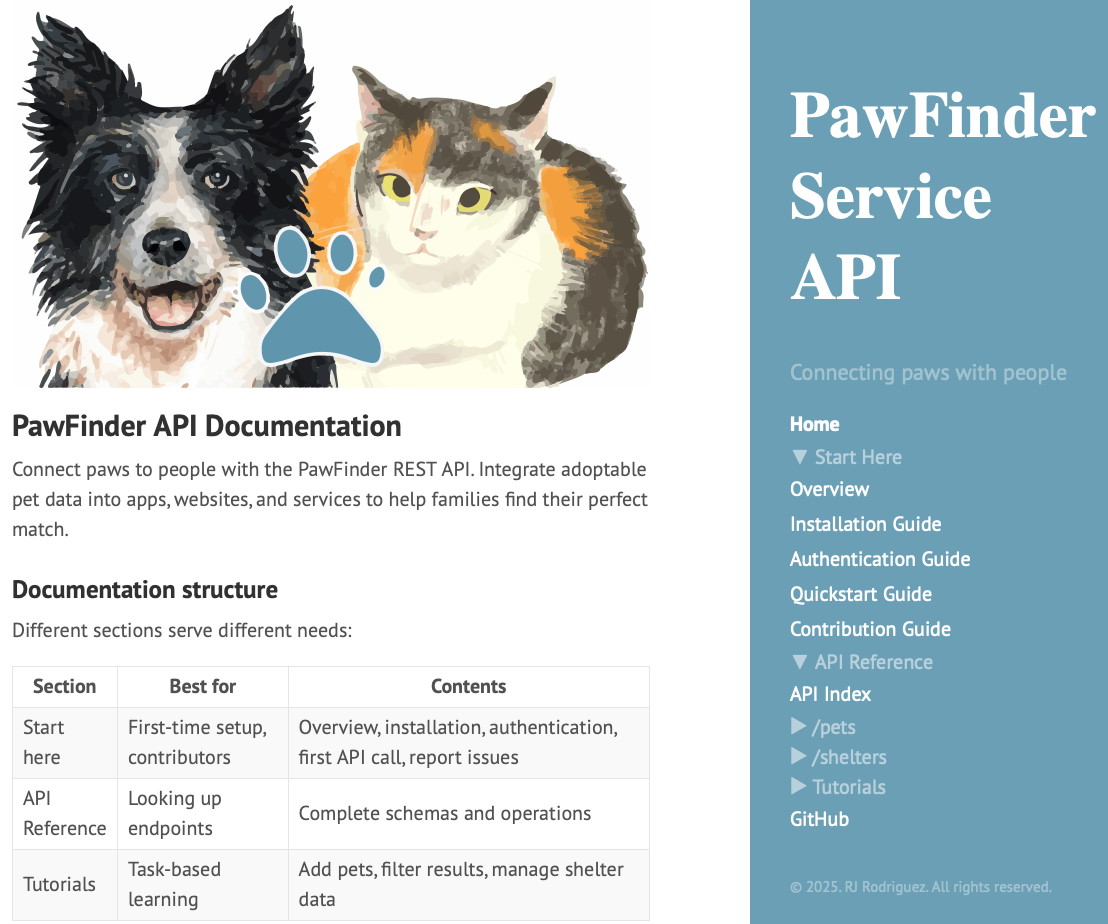
Example: PawFinder Service API docs
display a navigation hierarchy that organizes content by user need - setup,
reference, task-based learning - and specifically endpoints by resource
type, /pets and /shelters, then by function and/or CRUD operation
Related Terms: accessibility, CCMS, content, content governance, content strategy, CRUD, Diátaxis, domain knowledge, knowledge graph, knowledge management, metadata, ontology, progressive disclosure, Seven-Action Documentation Model, taxonomy, technical communication, usability testing, UX
Sources:
- Geeks for Geeks: "Information Architecture: A Complete Guide for Beginners"
- Rosenfeld, Louis; Morville, Peter; Arango, Jorge. Information Architecture: For the Web and Beyond - Fourth Edition, O'Reilly Media Inc., October 2015.
knowledge management
Definition: also known as KM; organizational discipline focused on creating, structuring, sharing, and maintaining collective knowledge, so that the right information reaches the right people at the right time
Purpose: situates API documentation within a broader organizational context; tech writers frequently work within or alongside knowledge management functions, particularly in support, enterprise, and developer-facing organizations where docs serve as the primary vehicle for capturing and distributing institutional and product knowledge
types of knowledge
| Type | Definition | Docs Challenge | API Docs Example |
|---|---|---|---|
| Tacit | acquired through experience and intuitively understood; difficult to articulate or transfer | hardest to capture; exists in the minds of senior engineers and experienced API users | reasons for design decisions; how to debug an obscure edge case |
| Implicit | undocumented process know-how; awaiting codification | docs gap risk; often lost during team transitions or engineer departures | internal conventions for versioning, unwritten rules about rate limit behavior |
| Explicit | captured in docs, manuals, guides, and databases; easily shared across teams | most of what docs teams produce; the foundation of API reference and guides | API reference docs, error code tables, getting started guides |
KM process
| Step | What Happens | API Docs Equivalent |
|---|---|---|
| Creation | identify and document existing or new knowledge | writing API reference, capturing tacit knowledge from engineers, documenting new endpoints |
| Storage | host organizational knowledge in a system for distribution | publishing to a docs site, DAM, or knowledge base; version controlling in a repository |
| Sharing | communicate processes for knowledge access broadly across the organization | developer portals, internal wikis, search optimization, notification of doc updates |
KM tools
| KM Tool Type | What It Does | API Docs Equivalent |
|---|---|---|
| Document Management System | centralized storage for documents and/or digital assets | DAM, Git repository, docs-as-code platforms |
| CMS | manages web content with editing and publishing workflows | developer portals, Confluence, readme.com |
| Wiki | easy-to-edit collaborative knowledge base; risk of outdated content | internal engineering wikis, Notion, Confluence |
| Intranet | private organizational network for internal knowledge sharing | internal API documentation behind authentication |
| Data warehouse | aggregates data from multiple sources for analysis | analytics platforms tracking doc usage, search queries, time-to-first-successful-API-call |
Example: docs teams embedded in KM functions tend to prioritize findability, taxonomy, content reuse, and governance; approaching API docs as a knowledge asset to maintain rather than a shipping artifact to produce; this contrasts with engineering-embedded teams, who often prioritize docs-as-code workflows, and marketing-embedded teams, who emphasize sales collateral and developer acquisition
| Organizational Home | Documentation Priorities | Common Tools and Approaches |
|---|---|---|
| Knowledge Management | findability, taxonomy, governance, content reuse | DAM, structured content, metadata |
| Engineering | accuracy, versioning, automation, CI/CD integration | docs-as-code, docs-as-tests, static site generators |
| Marketing | developer acquisition, use cases, sales collateral | landing pages, tutorials, API overviews |
| Support | troubleshooting, error resolution, FAQs | knowledge bases, search optimization |
Related Terms: CCMS, CMS, content governance, content strategy, curse of knowledge, DAM, docs-as-code, docs-as-ecosystem, domain knowledge, information architecture, market, metadata, ontology, progressive disclosure, sales collateral, self-healing system, taxonomy, technical communication
Sources:
market
Definition: the space in which customers access a company or products that compete with similar offerings
Purpose: influences content priorities and documentation strategy based on competitive positioning, as an open source API competing in a crowded marketplace needs different documentation emphasis than a proprietary enterprise API with few alternatives; market position determines whether documentation should focus on differentiation, ease of adoption, or enterprise features
Example: a new authentication API entering a market dominated by established players needs documentation that highlights unique features and migration guides from competitors, while an established API can focus on advanced use cases and optimization
Related Terms: API overview topic, content strategy, knowledge management, sales collateral
Source: Docs By Design: "Audience, Market, Product Webinar"
ontology
Definition: in information science, a formal, explicit specification of concepts, categories, and relationships within a domain that defines what entities exist, what properties they have, and how they relate to each other
Purpose: enables API documentation teams to build shared understanding of domain concepts across writers, engineers, and tools; provides the semantic foundation that powers knowledge graphs, improves search relevance, and enables AI systems to reason about documentation content - going beyond taxonomy's hierarchical classification to capture richer, more nuanced relationships between concepts
Why this belongs in Frameworks & Strategy: represents a
foundational conceptual model for organizing domain knowledge rather
than a specific tool or operational practice; ontology is the
meta-level framework that informs how tech writers structure taxonomy,
information architecture, and knowledge graphs, similar to how
docs-as-ecosystem frames documentation philosophy rather than describing
specific workflows
ontology vs taxonomy
| Taxonomy | Ontology | |
|---|---|---|
| Primary Function | classifies concepts hierarchically | defines concepts, their properties, and relationships |
| Structure | tree: parent → child categories | graph: nodes with properties and named relationships |
| Example | Authentication → OAuth 2.0 → Token Management | Refresh Token is a type of Token, has property expiration_window, replaces Access Token when it expires |
| Answers | "What category does this belong to?" | "What is this, what can it do, and how does it connect to everything else?" |
Is this glossary an ontology?
ADG, API Docs Glossary, practices ontology-informed thinking without implementing a
formal ontology. The Related Terms links define named relationships between
concepts, category placement defines what kind of thing each term is, and
Why this belongs in fields make classification rules explicit - all ontological
practices. However, a formal ontology would express these relationships in a
machine-readable specification like OWL or
RDF so a system could reason over them,
rather than in human-readable Markdown. ADG is better described as an
ontology-informed taxonomy - applying ontological thinking to documentation
without the computational overhead of a formal specification.
Example: a payments API docs team builds an ontology to support AI-assisted search and content recommendations; because the ontology defines how concepts connect, a search for "payment failure" surfaces not just pages containing those words but also related webhook events, error code references, and troubleshooting guides -
| Concept | Type | Properties | Relationships |
|---|---|---|---|
Payment | Entity | amount, currency, status | initiates → Transaction |
Transaction | Entity | id, timestamp, result | requires → Authentication |
Webhook | Entity | event_type, endpoint_url | triggers on → Payment status change |
Error Code | Entity | code, http_status, message | describes failure of → Transaction |
Related Terms: content strategy, docs-as-ecosystem, domain knowledge, information architecture, knowledge graph, metadata, taxonomy, technical communication
Sources:
- The Metaphysics Research Lab, Stanford Encyclopedia of Philosophy: "Logic Ontology"
- W3C: "OWL 2 Web Ontology Language Document Overview (Second Edition)"
- Wikipedia: "Ontology (information science)"
sales collateral
Definition: materials used internally to inform sales representatives or externally to educate and convert prospective customers
Purpose: bridges the gap between technical documentation and business value communication; technical writers often create or contribute to sales collateral by translating API capabilities into business benefits, use cases, and ROI, return on investment, narratives that sales teams and prospects can understand without deep technical knowledge
Example: a technical writer transforms detailed webhook documentation into a one-page sales sheet explaining how real-time notifications reduce customer support tickets by 40%, using non-technical language and business metrics
Related Terms: API overview topic, content, content strategy, knowledge management, market
Sources:
self-healing system
Definition: architectural design philosophy where a system automatically detects failures, inconsistencies, or drift from an expected state and recovers with little and/or without human intervention — in API documentation contexts, a docs ecosystem that identifies inaccuracies caused by product changes and surfaces or resolves them through automated testing and validation
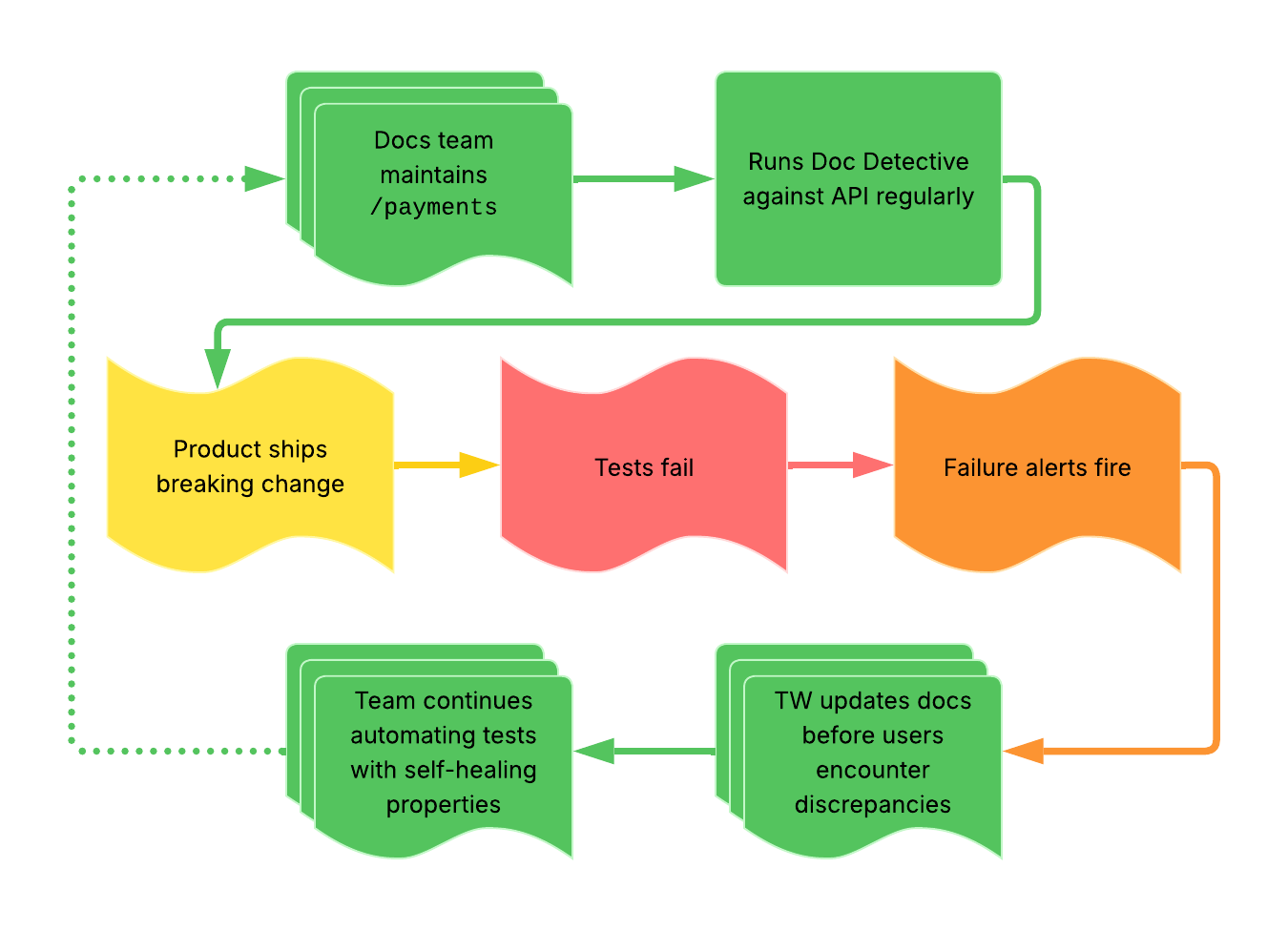
Purpose: reduces docs drift by shifting from reactive maintenance — fixing docs after users report errors — to proactive, automated detection; in API docs workflows, docs-as-tests implementations create self-healing properties by running continuous validation against live APIs, catching broken endpoints, outdated parameters, or inaccurate code examples before they reach users
Why this belongs in Frameworks & Strategy: describes a strategic approach to system
resilience rather than a specific tool or operational workflow; not a methodology, but a
conceptual model that informs how docs teams architect their validation pipelines and plan
for long-term accuracy; Workflows & Methodologies covers the operational practices like
docs-as-tests that implement self-healing properties, while Frameworks & Strategy
covers the strategic thinking that motivates those practices
SH-docs vs. SH-API
| self-healing API | self-healing docs | |
|---|---|---|
| Layer | infrastructure | documentation |
| Detects | dropped connections, timeouts, cascading errors | divergence between documented and actual behavior |
| Recovery Method | automatically restoring failed connections | flagging inaccuracies for correction |
| Philosophy | detect, recover, adapt | detect, recover, adapt |
Example: self-healing system workflow with Doc Detective -
Related Terms: API documentation testing, Doc Detective, docs-as-code, docs-as-tests, knowledge management, technical communication
Sources:
- Microsoft, Azure Architecture Center: "Design for self-healing"
- Silva, Manny. Docs As Tests. First edition, Release 2, Boffin Education, May 2025.
Seven-Action Documentation Model
Definition: a model of what user actions docs are meant to satisfy, treating docs as a product that someone will use to achieve actual goals; identifies seven core actions that cover the range of needs a reader brings to docs
Purpose: provides a framework for evaluating and planning docs through the lens of user needs rather than content types or structural templates; helps writers and teams identify gaps in their docs by asking which user actions are and aren't supported, rather than which content types are present or absent
Why this belongs in Frameworks & Strategy: describes a
strategic and conceptual lens for docs planning rather than an
operational workflow; similar to docs-as-ecosystem -
it reframes why docs are produced rather than how; directly addresses the
strategic failure mode that produces docs theater —
the prescriptive emphasis on what docs must be produced instead of what user needs
should be addressed
the seven actions
| Action | Users Need | Doc Types |
|---|---|---|
| Appraise (Discern) | Evaluate whether the product fits their needs | Product overview, service description |
| Understand (Learn) | Grasp core abstractions and concepts | Conceptual guide, explanation |
| Explore (Discover) | Interact and try things with low barrier to entry | Quick start, sandbox, tutorial |
| Practice (Train) | Learn how to operate the product in standard use | How-to guide, user guide |
| Remember (Recall) | Look up parameters, values, and syntax | API reference, command reference |
| Develop (Integrate) | Build on, extend, or integrate with the product | Integration guide, extension docs |
| Troubleshoot (Solve) | Diagnose and resolve issues | Troubleshooting guide, error reference |
Seven-Action vs related terms
| Term | Description | Distinction | Compatibility |
|---|---|---|---|
| DDLC | Document Development Life Cycle describes how docs get produced; Seven-Action Model describes what docs should accomplish for readers | Operate at different levels | Fully compatible |
| docs theater | docs theater produces content satisfying structural and/or formal requirements without serving readers | Affirmative vs hollow compliance | Seven-Action Model is the antidote to docs theater |
Example: a team audits their API docs against the Seven-Actions and discovers strong coverage of Remember (reference) and Practice (how-to guides) but no Appraise content — readers can't evaluate whether the API fits their use case without leaving the docs; they add an overview that directly addresses adoption decisions
Related Terms: banner blindness, CTA, docs observability, docs theater, Document Development Life Cycle, docs-as-ecosystem, DX, information architecture, UX
Source: passo.uno: "The Seven-Action Documentation Model" by Fabrizio Ferri Benedetti
skunkworks
Definition: a group within an organization given high autonomy and freedom from bureaucracy to work on advanced or experimental projects
Purpose: affects documentation approach for APIs and features developed in skunkworks environments as these projects often have minimal initial documentation, rapid iteration cycles, and uncertain futures, requiring flexible documentation strategies that balance thoroughness with the reality that features may change dramatically or risk discontinuation
Example: a skunkworks team building an experimental machine learning API may need lightweight, frequently updated documentation focused on current capabilities rather than comprehensive reference materials, with clear disclaimers about experimental status
Related Terms: Agile, project management methodologies
Sources:
taxonomy
Definition: hierarchical classification system that organizes concepts, terms, or entities into categories and subcategories based on their relationships and characteristics
Purpose: provides consistent structure for organizing and navigating API documentation, enabling users to find related endpoints, understand conceptual relationships, and build mental models of how API components relate to each other
taxonomy scope
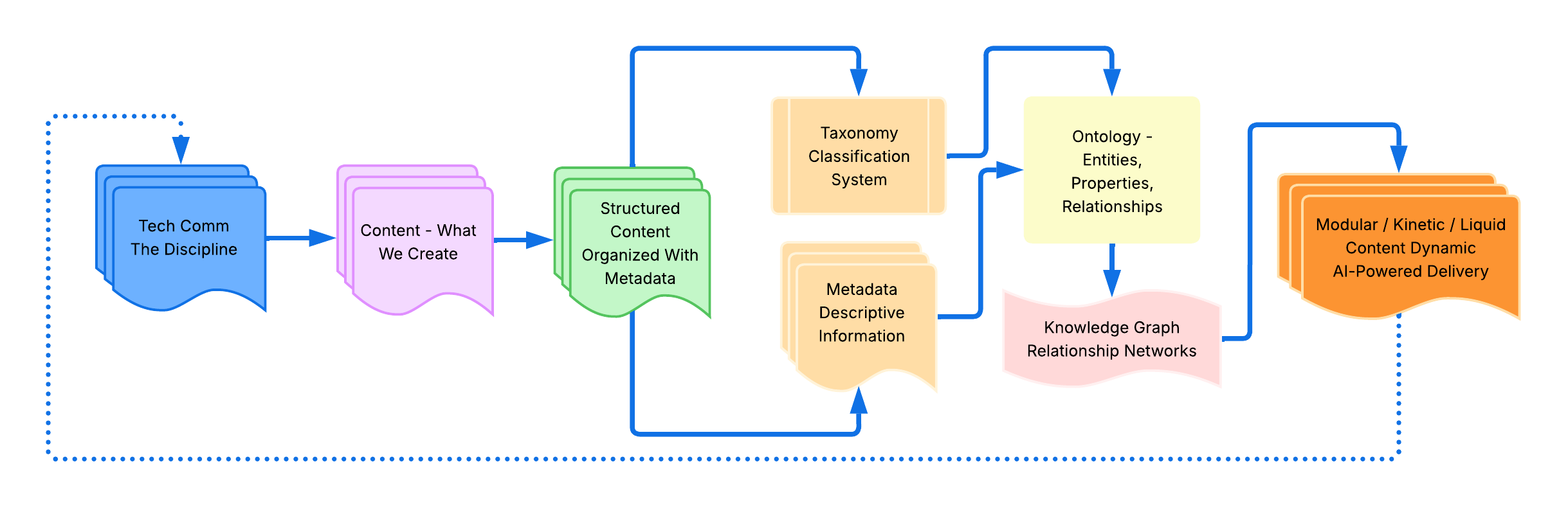
| Build Stage - Layer | Concept | Capability Unlocked |
|---|---|---|
| Stage 1: Foundation | Technical Comm → Content | Create documentation |
| Stage 2: Structure | + Structured Content | Reuse components systematically |
| Stage 3: Organization | + Taxonomy + Metadata | Classify, search, and describe content |
| Stage 4: Intelligence | + Knowledge Graph | Understand semantic relationships |
| Stage 5: Dynamic Delivery | + Modular/Kinetic/Liquid | AI-assisted, adaptive documentation experiences |
Example: an API documentation taxonomy might organize endpoints hierarchically or categorize error codes:
| Component | Organization |
|---|---|
| Endpoints | Authentication → OAuth 2.0 → Token Management → Refresh Token Endpoint |
| Error Codes | Client Errors (4xx) → Authentication Errors → 401 Unauthorized, 403 Forbidden |
Related Terms: content, DAM, domain knowledge, DSL, knowledge graph, knowledge management, information architecture, metadata, ontology, technical communication
Sources:
- Markup AI Europe, Acrolinx: "Building a Strong Content Taxonomy for Technical Documentation" by Hannah Kaufhold
- Wikipedia: "Taxonomy"
technical communication
Definition: also known as tech comm; professional field focused on creating documentation, instructions, and informational materials that help people accomplish specific tasks or understand technical concepts
Purpose: establishes the discipline within which API documentation practices, tools, and methodologies exist; encompasses writing, information design, user experience, and content strategy for technical audiences
Why this belongs in Frameworks & Strategy: represents the overarching
professional discipline and conceptual framework that contains all API
documentation work; Core Concepts focuses on API-specific fundamentals -
endpoints, authentication, responses - while technical communication is the
meta-level field that defines the nature of documentation work itself -
similar to how docs-as-ecosystem frames documentation philosophy rather than
describing specific API concepts
tech comm scope
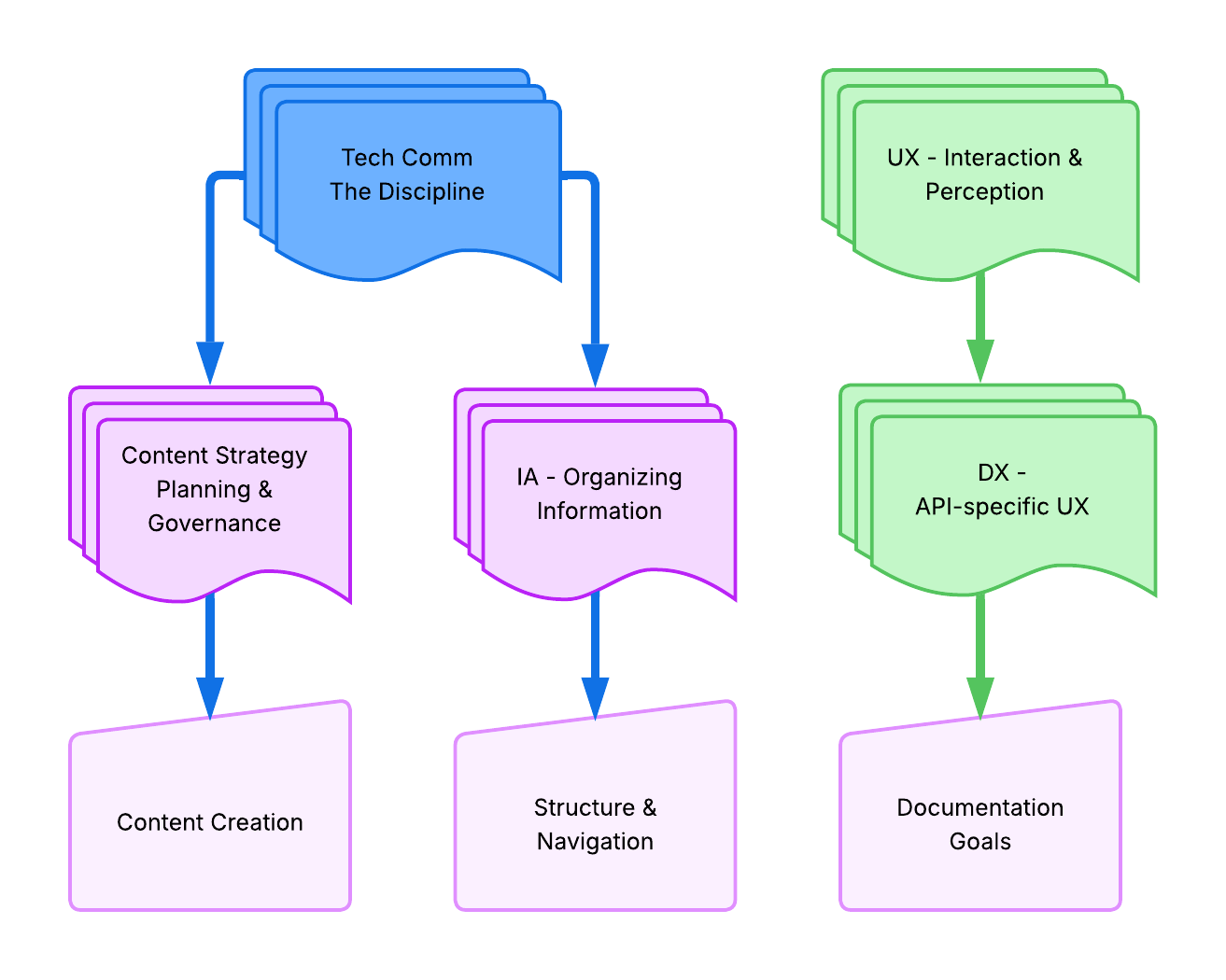
Example: API reference documentation, SDK tutorials, developer guides, installation instructions, and troubleshooting articles are all forms of technical communication created by technical communicators working in the API documentation domain
Related Terms: content, content strategy, docs-as-ecosystem, domain knowledge, information architecture, knowledge management, metadata, ontology, self-healing system, taxonomy
Sources:
UX
Definition: acronym for user experience; multidisciplinary field involving many stakeholders, drawing on principles from design, psychology, engineering and business; encompasses all aspects of a person's interaction with a product, service, or system, including their perceptions, emotions, and responses before, during, and after use
Purpose: guides API documentation decisions by focusing on DX, developer experience - how developers feel when discovering, learning, and using an API - ensuring documentation reduces friction, builds confidence, and supports successful integration
Example: improving API documentation UX
| Focus Area | Action | Impact |
|---|---|---|
| Interactivity | Add code examples developers can test immediately | Reduces friction between reading docs and first API call |
| Error Handling | Provide clear error messages with actionable solutions | Helps developers troubleshoot without leaving documentation |
| Content Organization | Surface authentication requirements before first API call | Prevents common blocker where developers attempt calls before authenticating |
| Code Samples | Ensure samples work copy-paste without modification | Eliminates guesswork and reduces time-to-first-successful-API-call |
Related Terms: accessibility, API documentation testing, banner blindness, cognitive dimensions of API usability, CTA, curse of knowledge, docs observability, DX, end-user software engineer, guerilla usability testing, information architecture, Seven-Action Documentation Model, usability testing
Sources:
- IBM: "What is user experience (UX)?" by Teganne Finn, Amanda Downie
- Interaction Design Foundation: "User Experience Design"
white-labeling
Definition: practice of rebranding a product or service for different clients or markets while maintaining the same underlying capability
Purpose: enables companies to offer customized documentation experiences for different customer segments without duplicating effort; in API documentation, allows maintaining multiple branded versions of docs that share core technical content but differ in branding, terminology, examples, and customer-specific features
Example: a payments API provider serves three banking clients with
white-labeled API docs; all three sites share identical endpoint references,
authentication flows, and error codes stored as Markdown includes, but each
displays different branding, custom domain names, client-specific webhook URLs,
and compliance disclaimers; when an API endpoint changes, updating the shared
include file propagates the change across all three branded documentation sites
Related Terms: monorepo, partials, polyrepo, static site generator
Sources:
- Docsie: "White-labeling"
- Fake Financial Engineering Hub: "Write Once, Brand Many: White-Labeling Docs"
- Wikipedia: "White-label product"